> For the complete documentation index, see [llms.txt](https://help.aikido.dev/llms.txt). Markdown versions of documentation pages are available by appending `.md` to page URLs; this page is available as [Markdown](https://help.aikido.dev/docs/docs-ja/sonono/private-registries/jfrog-artifactory.md).
# JFrog Artifactory
Aikido Registry Proxy を Artifactory のデフォルトのアップストリームとして使用し、チームがインストールするすべてのパッケージをマルウェア、年齢制限、既知の脆弱性についてチェックします。さらに、これによりインストールできます [Aikido Libraries](/docs/docs-ja/autofix-to/aikido-libraries-overview.md) お使いの Artifactory から直接。
{% stepper %}
{% step %}
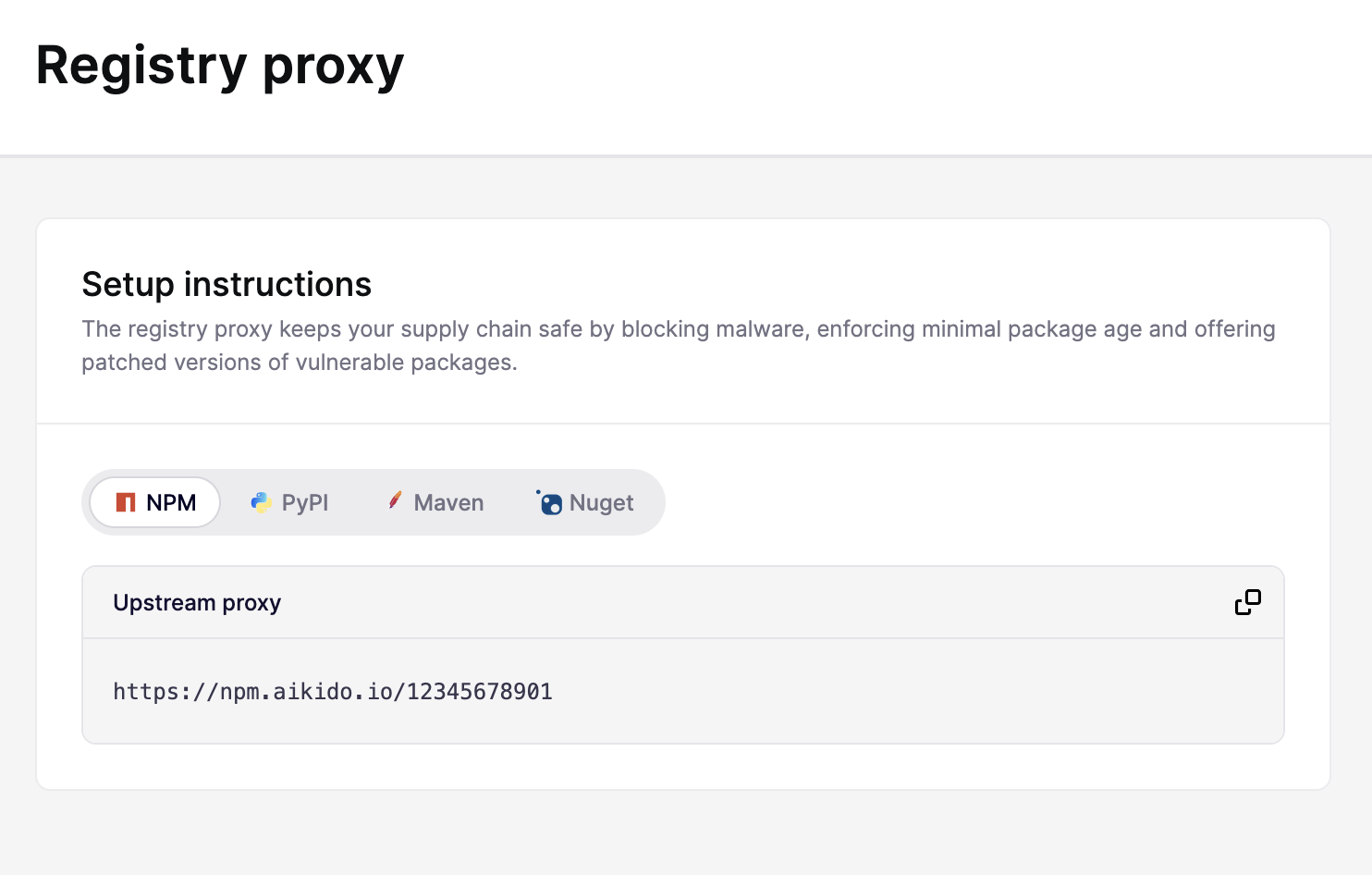
### Aikido のプロキシ URL を取得する
次へ移動します: [設定 > レジストリ プロキシ](https://app.aikido.dev/issues/aikido-libraries/setup-instructions)、対象のエコシステムを選択して upstream プロキシ URL をコピーします
{% endstep %}
{% step %}
### Artifactoryでリモートリポジトリを作成する
1. Artifactoryで、 **管理 > リポジトリ**.
2. クリックします **新規リポジトリ** and select **リモート**.
3. 次の項目を設定します: **パッケージタイプ**
4. リポジトリにキーを付けます。たとえば `aikido`.
5. 次を設定します **URL** フィールドに、手順1で取得したAikidoプロキシURLを入力します。
6. リポジトリを保存します。
{% hint style="info" %}
パッケージにAikidoの最新データが反映されない場合は、 **メタデータキャッシュの保持期間** を `0` をリモートリポジトリ設定で設定します。これにより、Artifactoryはキャッシュされたバージョンを返すのではなく、常にAikidoプロキシから最新のメタデータを取得するようになります。
{% endhint %}
{% endstep %}
{% step %}
### (任意)バーチャルリポジトリを作成する
ローカルのArtifactoryリポジトリに内部パッケージも保存している場合は、両方を集約するバーチャルリポジトリを作成します:
1. 次へ移動します: **管理 > リポジトリ > 新規リポジトリ > バーチャル**.
2. 次の項目を設定します: **パッケージタイプ** をリモートリポジトリに一致させる
3. ローカルリポジトリとリモートリポジトリをメンバーとして追加します。
4. 代わりに、パッケージマネージャーをバーチャルリポジトリのURLに向けます。
これにより、Aikidoを通じて内部パッケージと外部プロキシ済みパッケージの両方を提供する、チーム向けの単一のレジストリエンドポイントを利用できます。
{% endstep %}
{% step %}
### 開発者のマシンでArtifactoryを使用するように設定する
各開発者のパッケージマネージャーをArtifactoryリポジトリに向けます。正確な手順はJFrogのドキュメントを参照してください:
{% tabs %}
{% tab title="npm" %}
[npmリポジトリ - クライアントを接続する](https://docs.jfrog.com/artifactory/docs/npm-repositories#connect-your-npm-client-to-artifactory)
{% endtab %}
{% tab title="PyPI" %}
[PyPIリポジトリ - クライアントを接続する](https://docs.jfrog.com/artifactory/docs/pypi-repositories#connect-your-pypi-client-to-artifactory)
{% endtab %}
{% tab title="Maven" %}
[Mavenリポジトリ - クライアントを接続する](https://docs.jfrog.com/artifactory/docs/maven-repositories#connect-your-maven-client-to-artifactory)
{% endtab %}
{% tab title="NuGet" %}
[NuGetリポジトリ - クライアントを接続する](https://docs.jfrog.com/artifactory/docs/nuget-repositories#connect-your-nuget-client-to-artifactory)
{% endtab %}
{% endtabs %}
{% endstep %}
{% step %}
### (任意)Device Protection で公開レジストリをブロックする
Artifactoryを導入しても、開発者はパッケージマネージャーを公開レジストリに直接向けることで回避できます。すべてのトラフィックがプライベートレジストリを経由するよう強制するには、Aikido Device Protectionを導入してください。
{% content-ref url="/pages/7fa47c5a1ee5b3c664f0ab37ca9a23372513ddeb" %}
[公開パッケージレジストリをブロックする](/docs/docs-ja/aikido-device-protection/using-aikido-endpoint/block-public-package-registries.md)
{% endcontent-ref %}
{% endstep %}
{% endstepper %}
---
# Agent Instructions
This documentation is published with GitBook. GitBook is the documentation platform designed so that both humans and AI agents can read, navigate, and reason over technical content effectively. Learn more at gitbook.com.
## Querying This Documentation
If you need additional information that is not directly available in this page, you can query the documentation by asking a question.
Perform an HTTP GET request on the following URL with the `ask` and `goal` query parameters:
```
GET https://help.aikido.dev/docs/docs-ja/sonono/private-registries/jfrog-artifactory.md?ask=&goal=
```
`ask` is the immediate question: it should be specific, self-contained, and written in natural language.
`goal` is what the user is ultimately trying to achieve, the reason they need the answer. Sharing it helps GitBook give you a better, more relevant answer. A goal is most helpful when it describes the outcome the user wants rather than restating the question. For example, with `ask=how do I create an API token`, a goal like `automate deployments from our CI pipeline` lets GitBook tailor the answer to that use case.
The response will contain a direct answer to the question and relevant excerpts and sources from the documentation.
Use this mechanism when the answer is not explicitly present in the current page, you need clarification or additional context, or you want to retrieve related documentation sections.