> For the complete documentation index, see [llms.txt](https://help.aikido.dev/llms.txt). Markdown versions of documentation pages are available by appending `.md` to page URLs; this page is available as [Markdown](https://help.aikido.dev/ai-and-dev-tools/ide-plugins-overview/features/real-time-code-scanning-in-ide.md).
# Real-time SAST, Secrets and IaC scanning in IDE
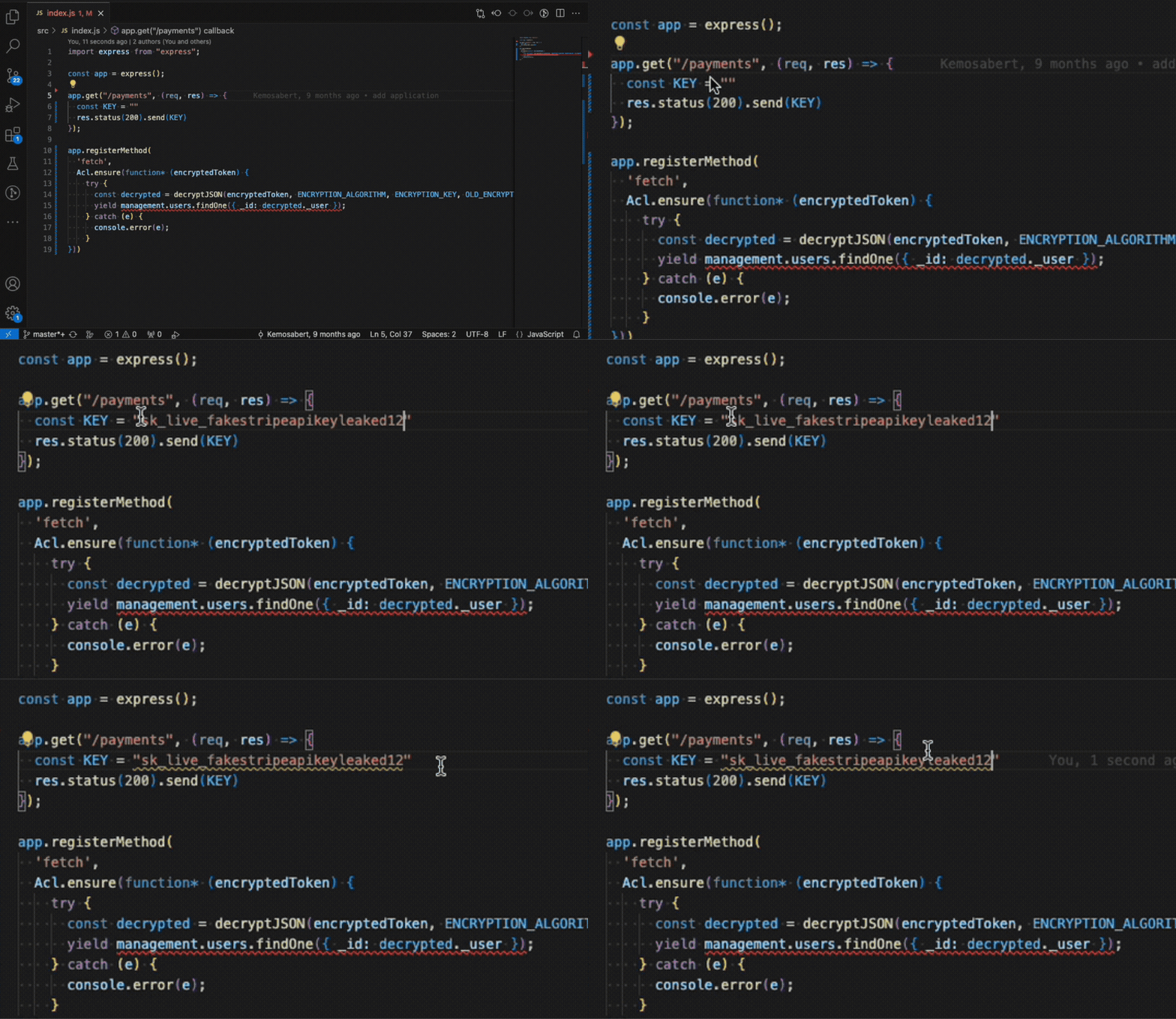
The Aikido IDE plugin helps you catch security issues the moment they’re introduced. Every time you open or save a file, Aikido runs a quick scan in the background and highlights problems directly in your editor.
#### What It Scans
Aikido performs two types of scans in real time:
* SAST (Static Application Security Testing): Detects insecure coding patterns, potential injections, unsafe deserialization, and other code-level vulnerabilities.
* Secrets: Finds exposed credentials such as API keys, passwords, or tokens.
* IAC: (Infrastructure as Code): Detects cloud and infrastructure misconfigurations in Terraform, CloudFormation, Dockerfiles, and similar files.
#### How It Works
When you open or save a file, Aikido scans the code using the same analysis engine as the Aikido platform.
Detected issues appear:
* Inline, underlined or highlighted in the editor.
* In the Aikido sidebar, grouped by severity and category.
* In the Problems panel, for quick navigation.
Hover over any finding to see context and remediation details. For supported findings, you can [analyse using AI Autotriage or apply an AI AutoFix](/ai-and-dev-tools/ide-plugins-overview/features/aikido-ai-in-ide.md) to safely patch the issue without leaving your IDE.
---
# Agent Instructions
This documentation is published with GitBook. GitBook is the documentation platform designed so that both humans and AI agents can read, navigate, and reason over technical content effectively. Learn more at gitbook.com.
## Querying This Documentation
If you need additional information that is not directly available in this page, you can query the documentation by asking a question.
Perform an HTTP GET request on the following URL with the `ask` and `goal` query parameters:
```
GET https://help.aikido.dev/ai-and-dev-tools/ide-plugins-overview/features/real-time-code-scanning-in-ide.md?ask=&goal=
```
`ask` is the immediate question: it should be specific, self-contained, and written in natural language.
`goal` is what the user is ultimately trying to achieve, the reason they need the answer. Sharing it helps GitBook give you a better, more relevant answer. A goal is most helpful when it describes the outcome the user wants rather than restating the question. For example, with `ask=how do I create an API token`, a goal like `automate deployments from our CI pipeline` lets GitBook tailor the answer to that use case.
The response will contain a direct answer to the question and relevant excerpts and sources from the documentation.
Use this mechanism when the answer is not explicitly present in the current page, you need clarification or additional context, or you want to retrieve related documentation sections.