> For the complete documentation index, see [llms.txt](https://help.aikido.dev/llms.txt). Markdown versions of documentation pages are available by appending `.md` to page URLs; this page is available as [Markdown](https://help.aikido.dev/ai-and-dev-tools/ide-plugins-overview/eclipse-ide.md).
# Eclipse IDE
Aikido automatically scans your projects for hardcoded secrets (API keys, tokens) and insecure code patterns (SQL injections, path traversal, ..) so you can catch issues early and keep your codebase safe.
Scans run automatically whenever you open a file or save changes, making it easy to catch issues early in development.
When security issues are found, they're highlighted directly in your code and listed in the Aikido window.
## Installation and Authentication
{% stepper %}
{% step %}
**Go to the** [**Eclipse marketplace**](https://marketplace.eclipse.org/content/aikido-security) **and install the Aikido Plugin**
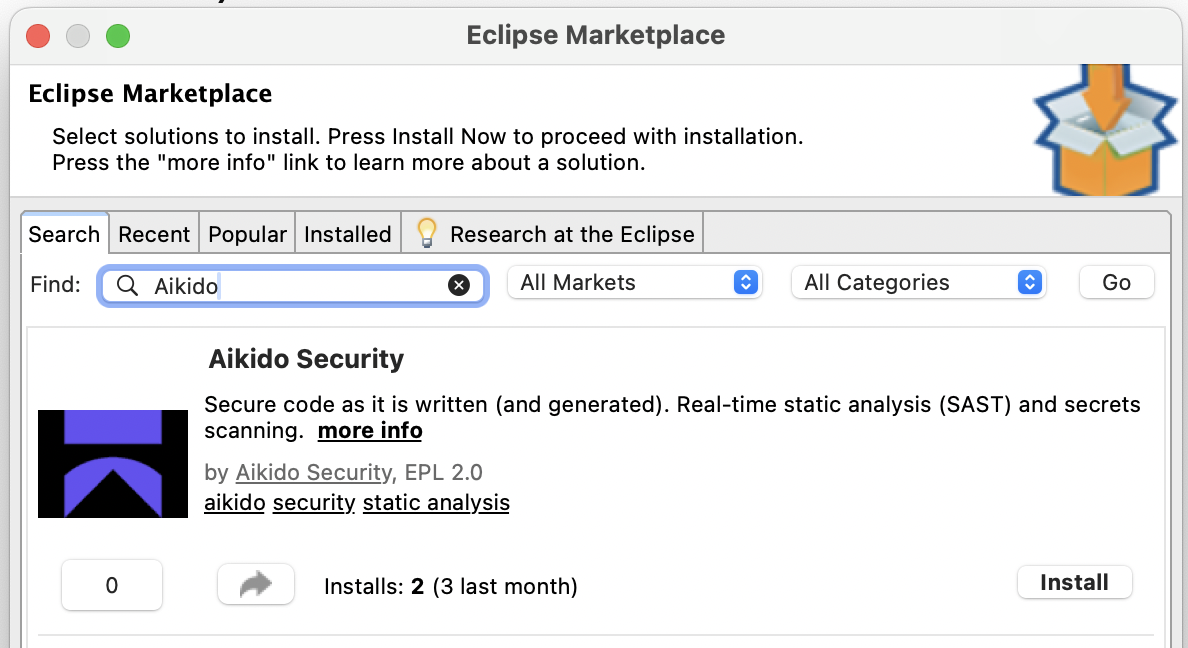
In Eclipse, go to `Help` > `Eclipse Marketplace...` and look for 'Aikido*'* in the search bar. Click 'Install'.
After installation, restart Eclipse.
{% endstep %}
{% step %}
**Authenticate with Aikido**
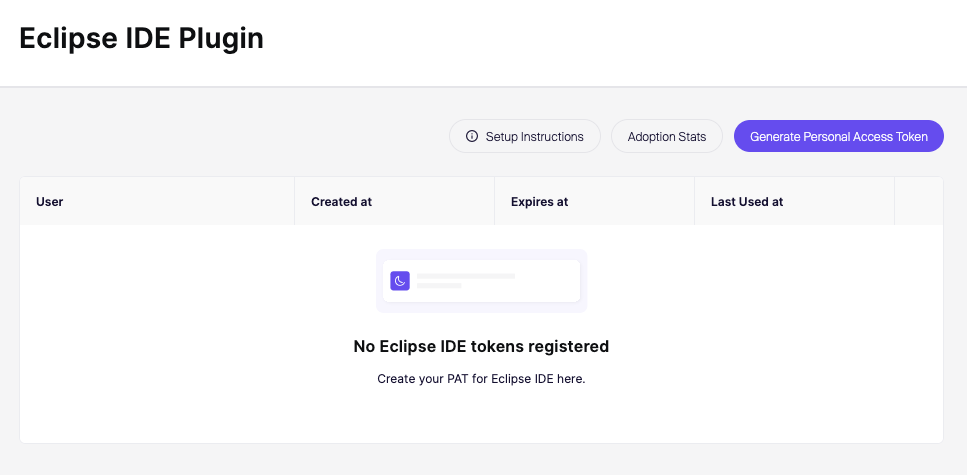
In Aikido, go to the [Eclipse Integration Screen](https://app.aikido.dev/settings/integrations/ide/eclipse) and create your token.
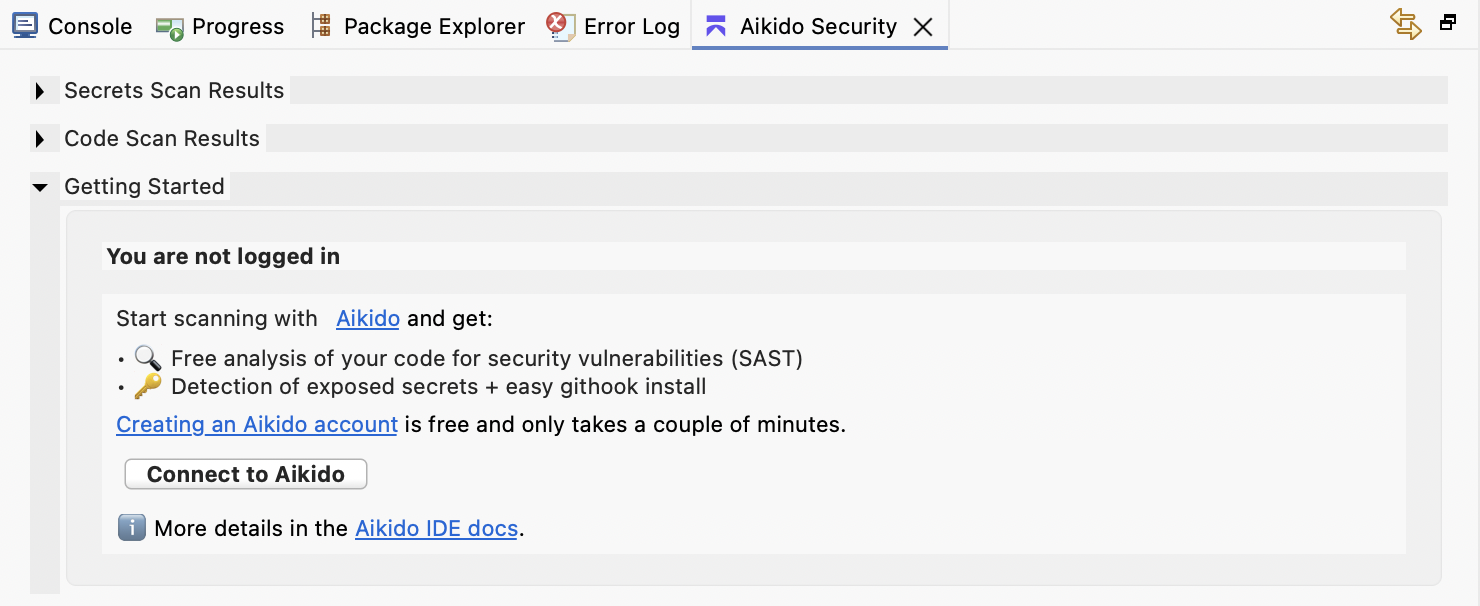
After installation the Aikido Security View will open automatically in Eclipse. If this is not the case, go to `Window` > `Show View` > `Other...` > Look for Aikido and select the 'Aikido Security' view. In the Aikido Security view, click `Connect to Aikido` and enter your token.
{% endstep %}
{% step %}
**Try out an example**
Below you can find an example `sample.java` file that can be used to verify if the extension is working correctly, it should detect one SAST issue on line 29 and one exposed secret on line 23.
```java
import java.sql.Connection;
import java.sql.DriverManager;
import java.sql.ResultSet;
import java.sql.Statement;
import javax.servlet.http.HttpServlet;
import javax.servlet.http.HttpServletRequest;
import javax.servlet.http.HttpServletResponse;
import com.google.gson.Gson;
import java.io.IOException;
import java.util.ArrayList;
import java.util.HashMap;
import java.util.List;
import java.util.Map;
public class UserServlet extends HttpServlet {
@Override
protected void doGet(HttpServletRequest req, HttpServletResponse res)
throws IOException {
String connStr = "jdbc:sqlserver://myserver.database.windows.net:1433;" +
"database=mydb;" +
"user=myuser;" +
"password=$uperSecret123!@#;" +
"encrypt=true;" +
"trustServerCertificate=false;" +
"loginTimeout=30;";
String username = req.getParameter("username");
String unsafeQuery = "SELECT * FROM users WHERE username = '" + username + "'";
try (Connection conn = DriverManager.getConnection(connStr);
Statement stmt = conn.createStatement();
ResultSet result = stmt.executeQuery(unsafeQuery)) {
// Convert ResultSet to JSON-like structure
List> resultList = new ArrayList<>();
int columnCount = result.getMetaData().getColumnCount();
while (result.next()) {
Map row = new HashMap<>();
for (int i = 1; i <= columnCount; i++) {
row.put(result.getMetaData().getColumnName(i),
result.getObject(i));
}
resultList.add(row);
}
res.setStatus(200);
res.setContentType("application/json");
res.getWriter().write(new Gson().toJson(resultList));
} catch (Exception e) {
res.setStatus(500);
res.getWriter().write("Error: " + e.getMessage());
}
}
}
```
{% endstep %}
{% endstepper %}
### Uninstall
To uninstall the Aikido Eclipse plugin:
Go to `Help` > `Eclipse Marketplace...` > `Installed` > Look for Aikido Security and click `Uninstall`
---
# Agent Instructions
This documentation is published with GitBook. GitBook is the documentation platform designed so that both humans and AI agents can read, navigate, and reason over technical content effectively. Learn more at gitbook.com.
## Querying This Documentation
If you need additional information that is not directly available in this page, you can query the documentation by asking a question.
Perform an HTTP GET request on the following URL with the `ask` and `goal` query parameters:
```
GET https://help.aikido.dev/ai-and-dev-tools/ide-plugins-overview/eclipse-ide.md?ask=&goal=
```
`ask` is the immediate question: it should be specific, self-contained, and written in natural language.
`goal` is what the user is ultimately trying to achieve, the reason they need the answer. Sharing it helps GitBook give you a better, more relevant answer. A goal is most helpful when it describes the outcome the user wants rather than restating the question. For example, with `ask=how do I create an API token`, a goal like `automate deployments from our CI pipeline` lets GitBook tailor the answer to that use case.
The response will contain a direct answer to the question and relevant excerpts and sources from the documentation.
Use this mechanism when the answer is not explicitly present in the current page, you need clarification or additional context, or you want to retrieve related documentation sections.