> For the complete documentation index, see [llms.txt](https://help.aikido.dev/llms.txt). Markdown versions of documentation pages are available by appending `.md` to page URLs; this page is available as [Markdown](https://help.aikido.dev/pr-and-release-gating/gitlab-mr-gating/gitlab-ci-mr-gating-via-aikido-dashboard.md).
# GitLab MR Gating via Aikido Dashboard
### Introduction
You can easily configure GitLab MR Gating via the Aikido interface. This functionality allows you to block any **newly introduced** issues for a certain threshold that you decide. This doc focusses on managing configurations in bulk - multiple repos at the same time - without code.
### Use Cases
* **Bulk Repository Management**: Easily specify and manage configurations for multiple repositories at once through the Aikido interface.
* **Zero Code Integration**: Install the Aikido app on GitLab to manage checks without embedding any code, simplifying the setup process.
* **Cost Efficiency**: By managing GitLab Checks through Aikido, avoid using CI minutes on GitLab, leading to significant cost savings.
### Setting up GitLab CI
**Step 1.** Go to the [Integrations Page](https://app.aikido.dev/settings/integrations) and select GitLab in the CI gating section.

**Step 2.** Consent to the **Aikido MR Checks OAuth app** in GitLab. Make sure that you select the GitLab group that is currently being used in your workspace.

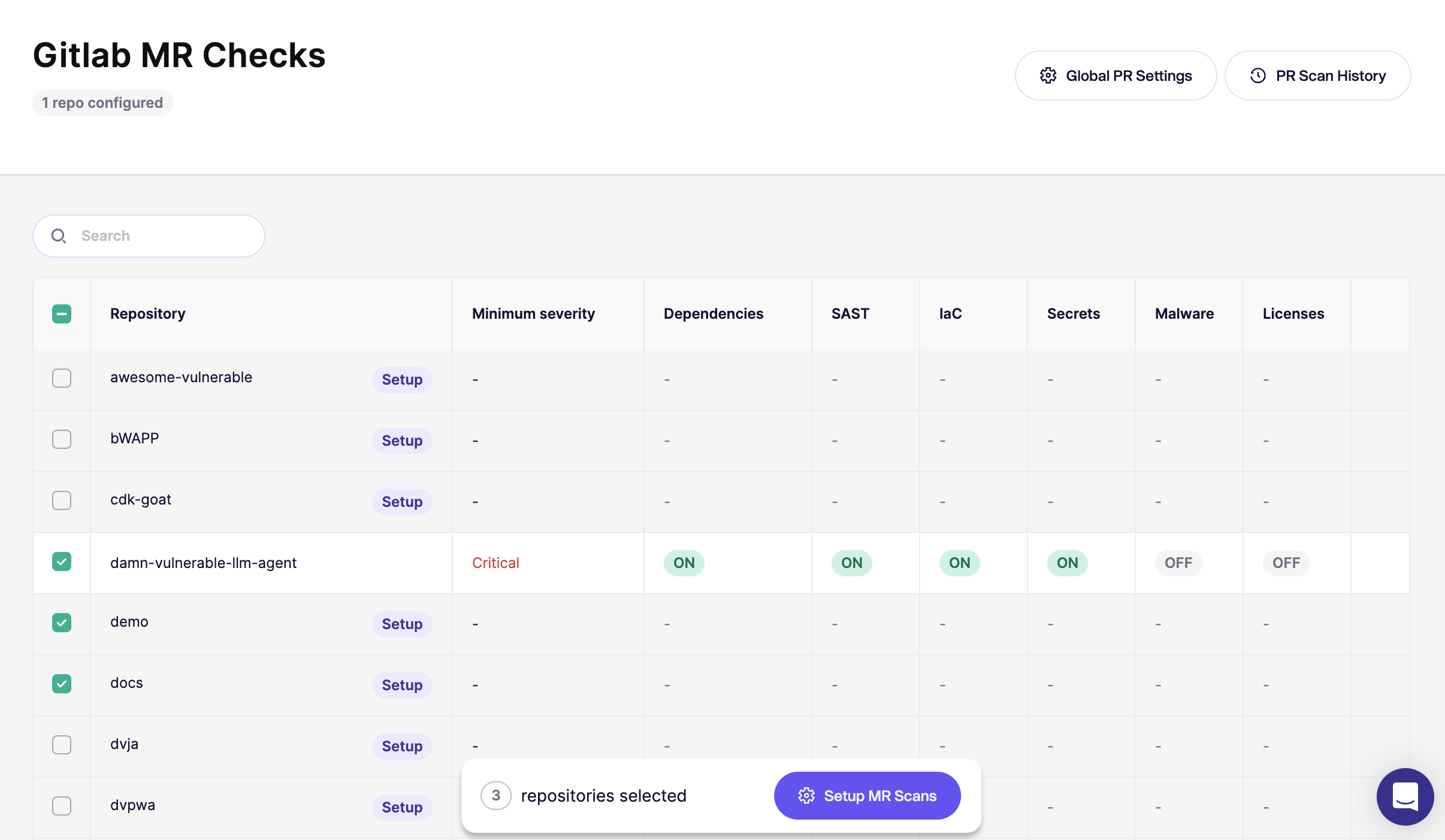
**Step 3.** Aikido redirects you to the [GitLab CI page](https://app.aikido.dev/settings/integrations/github/checks) with an overview of your repos. You can start configuring your repos. We recommend starting out with 1 repo to make sure everything works well.
**Step 4. Select repos in bulk** and click **Setup MR Scans** button in the floating bulk action bar on the bottom.
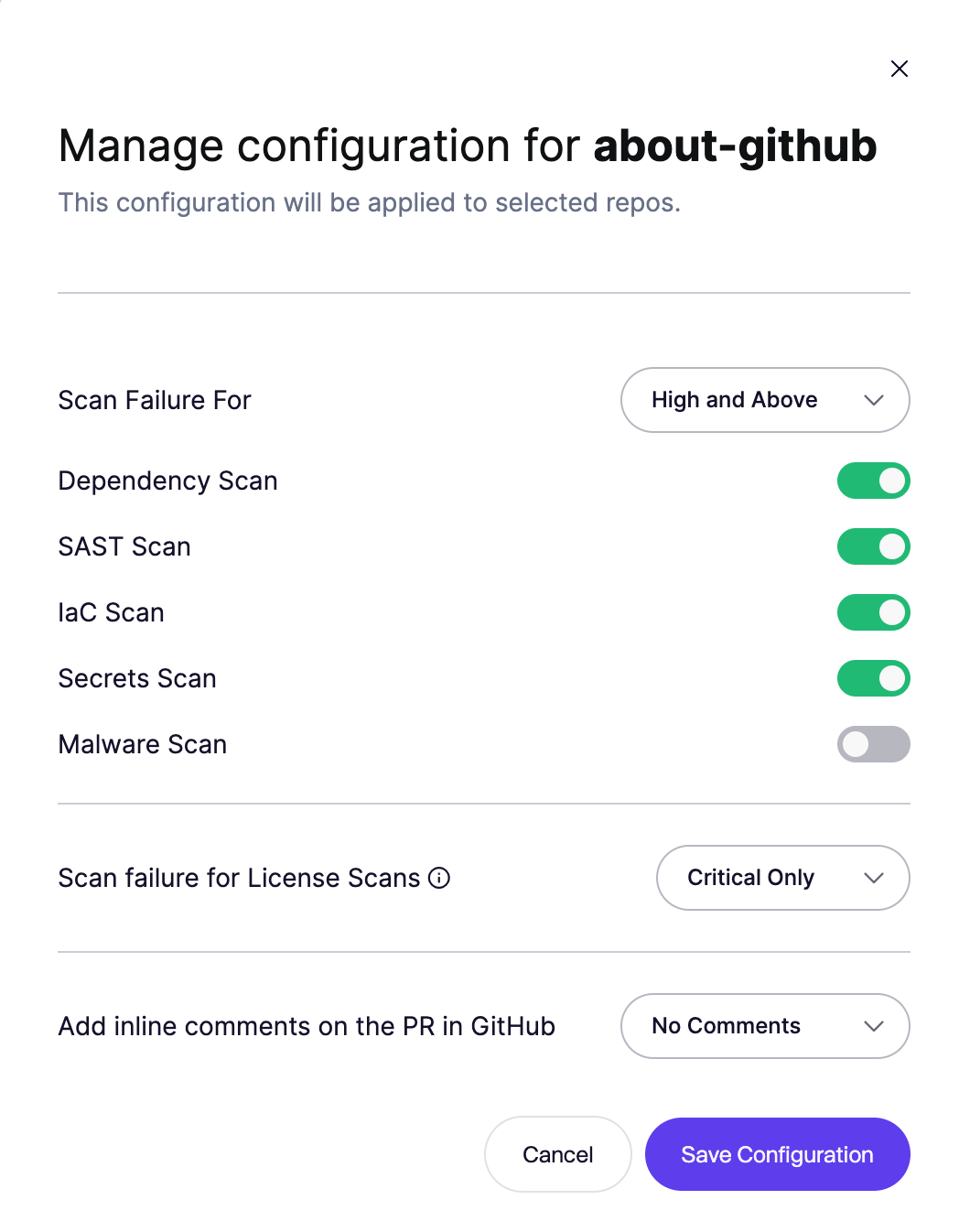
**Step 5.** This opens the configuration modal, where you choose the failure threshold and scans for the selected repositories.
To run the enabled scans without failing the GitLab MR check, select **Always Pass**.
{% hint style="info" %}
If you've added new repositories after the initial setup, you'll need to configure those repos as well.
To apply a default configuration automatically, see [Default PR/MR gating configuration for new repositories](/pr-and-release-gating/aikido-ci-gating-functionality/default-pr-mr-gating-configuration-for-new-repositories.md).
{% endhint %}
### Adding Exceptions for specific repos
You might want to have 1 specific repo where the configuration slightly differs. You can easily add exceptions by clicking the triple dots on a repo item or just select 1 or more items and go through the **Configure Scans** process again.

---
# Agent Instructions
This documentation is published with GitBook. GitBook is the documentation platform designed so that both humans and AI agents can read, navigate, and reason over technical content effectively. Learn more at gitbook.com.
## Querying This Documentation
If you need additional information that is not directly available in this page, you can query the documentation by asking a question.
Perform an HTTP GET request on the following URL with the `ask` and `goal` query parameters:
```
GET https://help.aikido.dev/pr-and-release-gating/gitlab-mr-gating/gitlab-ci-mr-gating-via-aikido-dashboard.md?ask=&goal=
```
`ask` is the immediate question: it should be specific, self-contained, and written in natural language.
`goal` is what the user is ultimately trying to achieve, the reason they need the answer. Sharing it helps GitBook give you a better, more relevant answer. A goal is most helpful when it describes the outcome the user wants rather than restating the question. For example, with `ask=how do I create an API token`, a goal like `automate deployments from our CI pipeline` lets GitBook tailor the answer to that use case.
The response will contain a direct answer to the question and relevant excerpts and sources from the documentation.
Use this mechanism when the answer is not explicitly present in the current page, you need clarification or additional context, or you want to retrieve related documentation sections.