> For the complete documentation index, see [llms.txt](https://help.aikido.dev/llms.txt). Markdown versions of documentation pages are available by appending `.md` to page URLs; this page is available as [Markdown](https://help.aikido.dev/autofix-and-remediation/connect-private-packages/nuget-private-packages.md).
# NuGet - Private Packages
For Aikido to update dependencies that include private packages, it needs access to your private NuGet registries so it can generate accurate lockfile updates.
Aikido supports 2 ways of configuring connections with your private NuGet registry:
1. Via a `nuget.config` file
2. Via credentials for the dotnet cli
## 1. Configuration via nuget.config file
### Prerequisites
For private NuGet packages, Aikido uses a `nuget.config` file to authenticate with the private registry. This file will overwrite the `nuget.config` in the root of the repository. It is possible to configure multiple private registries in this file.
Example `nuget.config` for accessing private packages on GitHub's NuGet registry:
```
```
Take a look at the following docs for more information on authenticating with private NuGet registries.
* [Microsoft - Consuming packages from authenticated feeds](https://learn.microsoft.com/en-us/nuget/consume-packages/consuming-packages-authenticated-feeds)
* [GitHub - Working with the NuGet registry](https://docs.github.com/en/packages/working-with-a-github-packages-registry/working-with-the-nuget-registry)
## Configuration in Aikido
Once the prerequisites are fulfilled, you can configure Aikido to authenticate with your private NuGet registry when updating the dependencies by following the steps below:
1. Go to your account's settings page for the Autofix in Aikido, [here](https://app.aikido.dev/issues/fix/settings).
2. Click on "Connect Registry", the private registry modal will now be shown
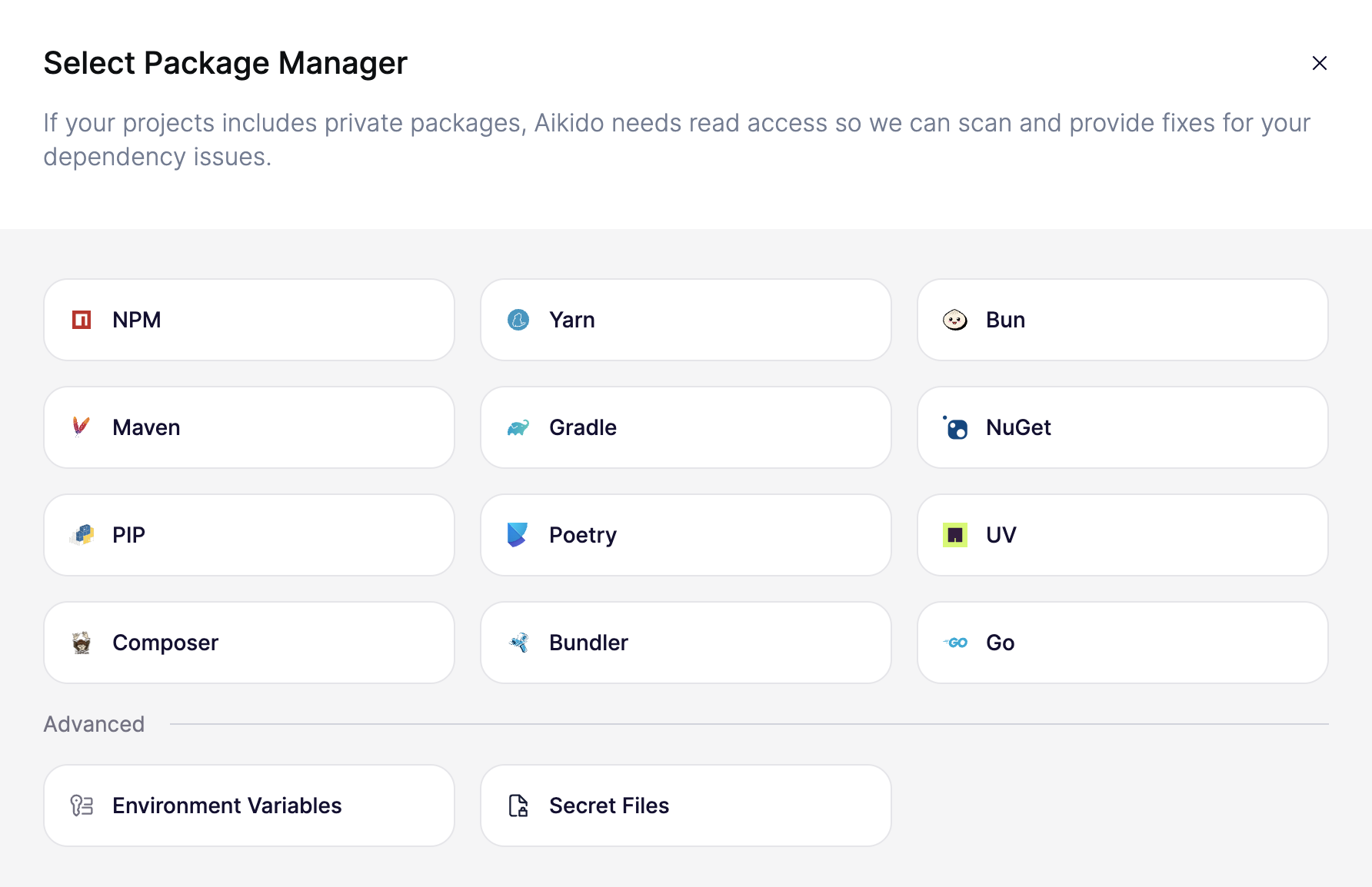
3. Select "Nuget" as package manager and select the `nuget.config` option
4. Fill in your `nuget.config` with authentication information. Aikido securely encrypts your configuration file until just before they are used.
5. Click "Connect Registry" to save the configuration
## 2. Configuration via .NET's nuget CLI
For the CLI config, Aikido needs to have the registry's URL, username and password which can be used to authenticate with the private registry. Once you have this information, you can configure it following the steps below:
1. Go to your account's settings page for the Autofix in Aikido, [here](https://app.aikido.dev/issues/fix/settings).
2. Click on "Connect Registry", the configuration modal will now be shown
3. Select "Nuget" as package manager and then select the "NuGet CLI Registry" option
4. Enter the details in the input fields and click on "Connect Registry" to save the configuration
## 3. Configuration via environment variables
For NuGet, you can also provide credentials through an environment variable in Autofix.
This requires a `nuget.config` file in your repository that defines the private feed. The feed name in the environment variable must match the feed name in `nuget.config`.
1. Go to your account's settings page for Autofix in Aikido, [here](https://app.aikido.dev/issues/fix/settings).
2. Add the following environment variable:
1. Key: `NuGetPackageSourceCredentials_my-private-feed`
2. Value: `Username=user;Password=secret-pat`
The PAT must have package read access.
---
# Agent Instructions
This documentation is published with GitBook. GitBook is the documentation platform designed so that both humans and AI agents can read, navigate, and reason over technical content effectively. Learn more at gitbook.com.
## Querying This Documentation
If you need additional information that is not directly available in this page, you can query the documentation by asking a question.
Perform an HTTP GET request on the following URL with the `ask` and `goal` query parameters:
```
GET https://help.aikido.dev/autofix-and-remediation/connect-private-packages/nuget-private-packages.md?ask=&goal=
```
`ask` is the immediate question: it should be specific, self-contained, and written in natural language.
`goal` is what the user is ultimately trying to achieve, the reason they need the answer. Sharing it helps GitBook give you a better, more relevant answer. A goal is most helpful when it describes the outcome the user wants rather than restating the question. For example, with `ask=how do I create an API token`, a goal like `automate deployments from our CI pipeline` lets GitBook tailor the answer to that use case.
The response will contain a direct answer to the question and relevant excerpts and sources from the documentation.
Use this mechanism when the answer is not explicitly present in the current page, you need clarification or additional context, or you want to retrieve related documentation sections.